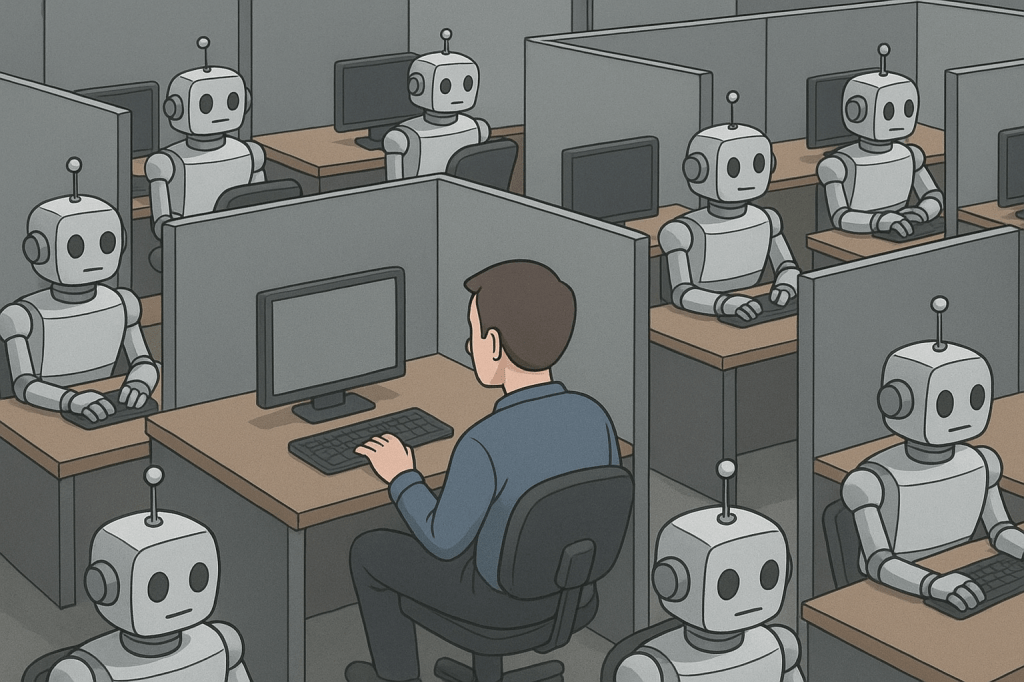
The question of how much compute it takes to replace humans in the workforce is unnecessarily reductive. Creating efficiencies does not guarantee humans will prefer a fully automated solution. More so, it does not mean it can’t be outcompeted by an automated solution wielded by a well-networked human.
While AI will likely be able to outpace humanity in cognitive and physical skills it will struggle to replace the human network of relevance, trust and relatability which are foundational pillars of economics.
AI automation has the ability to make us more human and pursue more fulfilling lives if we avoid protectionist policies that could arrest our progress.
Predicting the future is extremely difficult (yet quite lucrative if you manage to do it.) Right now with the rapid pace of artificial intelligence and the likelihood the robotics is also going to follow suit, a lot of us are looking around and trying to predict if automation (the term we’ll use here for AI and robotics) is about to make humans completely replaceable in the economy – and maybe even culturally.
There have been a number of research papers attempting to calculate the degree of impact of automation on the labor force. While I’ve found some of them interesting, I think they generally make several crucial mistakes in how they estimate the impact of automation:
Assumption 1. You can replace almost all human labor with an automation of comparable or greater intelligence and physical capacity.
Assumption 2. We will be unable to create new human-centric roles to fill the losses created by automation and that will lead to massive unemployment – possibly requiring entirely new governance and economic structures.
Having worked at OpenAI for four years and currently serving as the host of their official podcast, I’ve had quite a few conversations with people both inside the company and outside and have come to believe both of these assumptions are seriously flawed and I have a much more optimistic view of the role of human labor in a post-AGI world. My own view aside, let’s take a look at each one of these claims and see how well they actually stand up when analyzed more carefully.
Can you replace a human with automation?
In Pascual Restrepo’s paper “We Wont be Missed: Work and Growth in the Era of AGI”, he goes into detail to explain how people will be displaced from the workforce as the cost of compute falls and we start replacing human labor with automation. While I think the paper is worth reading and he makes several interesting points, the critical flaw is the assumption that with enough compute you can replace any human job – or at least all the ones relevant to economic growth. It also doesn’t go far enough in acknowledging the difference between a task and a job. While he acquiesces that there would still be some demand for humans in the performing arts and related fields, I think this ignores:
1. What the actual value of “soft skills” truly is.
2. How much economic growth is driven by these skills.
3. The difference between tasks and jobs (how something is done versus what gets done.)
4. How every other technological change has increased demand for work that goes beyond IQ and horsepower.
Restrepo argues that automated solutions will eventually be preferable to almost all human ones from a cost and efficiency point of view but makes the assumption that all work is replaceable with the right amount of compute. While he acknowledges that certain “accessory work” in the performing arts and related fields might still have some demand for humans, he considers them non-essential to growing the economy compared to “bottleneck work” like healthcare, energy, scientific advancement and food production. Aside from the fact that some aspects of bottleneck work require soft skills that are a bit more sophisticated than a friendly tone (networking, authenticity, peer trust, etc.) that can’t be replicated with automation, I think it’s much harder to disentangle the value accessory work and bottleneck work bring to the economy. It’s like trying to appraise the value of Manhattan real estate without Central Park or the market value of internet data capacity after 5pm without Netflix and K-Pop Demon Hunters. The presence of the latter adds value to the former. Our economy is not a top down system designed to solve a specific goal, it’s the product of the preferences of eight billion people. Even our preferences for our most critical needs like food and shelter are determined by cultural influences.
While you might make the argument that AI could provide competing services that end up being more attractive, in order for us to assume they’ll displace almost all human ones, we have to imagine a world where we’ve collectively decided to disassociate from one another. Since people still file into expensive sporting events shoulder-to-shoulder for a terrible view and some of us lament having to work remotely instead of in person, it stands to reason that at least some portion of humanity would still prefer to remain connected. For full human displacement we’d also have to make the decision that we prefer all the content and culture we consume to be automated. This seems unlikely. The reasons for why a show like K-Pop Demon Hunters is popular is connected to a number of human factors like people caring about K-Pop in the first place. Cultural influences redirect and amplify one another. Speaking as someone who has spent more time in the Sora AI video generator app in one week than Instagram and TikTok combined for the last five years, it’s replaced my algorithmic content, but not my intentional YouTube watching. Watching my friends in silly videos in Sora has value because my friends have value.
Putting aside the question of how much the production of human culture gives value to and shapes the economy, we should address if all “bottleneck jobs” or “essential work” can be performed by automation alone. Are people only useful in the arts in an automated world? Restrepo claims that even jobs in an essential sector like health care that people believe require a “human touch” are replaceable with enough compute. To make his point, he provides an example about therapy and asks rhetorically, “…would you insist on visiting a human therapist when you could instead be treated by this superhuman team of world experts?”
The problem with this question is that it presents a false dichotomy. A more fair question would be if you preferred an AI-only solution, a human-only solution or an AI-human solution of arguably the same quality of care as AI-only (with the added benefit of interacting with a fellow human.) I think people’s preferences would vary, but the choice wouldn’t be as clear as Restrepo suggests. You’ll encounter this arbitrarily forced choice in other arguments trying to make the case that human labor is replaceable.
Without having to see into the future we have overwhelming evidence that many people will often prefer AI-human and even human-only solutions regardless of quality. Assuming for the moment that in a blinded study AI therapists outperformed human therapists by a significant margin, would that mean the end of demand for human therapists? Probably not. Humans still talk to palm readers and astrologers and we’ve known since at least the middle ages they’re nonsense. You couldn’t ask for a lower bar than outperforming pseudoscience, yet here we are in 2025 with consumers spending billions of dollars a year on things we know don’t work. Neither psychic iPhone apps or AI-powered astrologers have dislodged humans from this questionable work. More people probably should use AI therapists, but that doesn’t mean they will.
The preference for humans reaches far into different parts of the economy. I know billionaires that would rather fly an author to their home for a discussion than spend the time reading the book. It doesn’t matter if the words the author is speaking are the same on the page, a high value is put on having someone with relevance to the information and conviction communicate them. It’s why we still sit in lectures and go to book signings. Time and experience are their own currencies.
Restrepo’s therapy example narrows the choice into an unlikely binary situation: Either you get the advantage of AI or you’re stuck with inefficient humans. Why not both? Extending this to something more measurable like physical therapy, would you rather talk to an AI-assisted human physical therapist with firsthand knowledge of your condition or an AI alone? For some people, having a physically perfect machine yell at them to feel the burn just wouldn’t resonate as much as having it come from someone who actually knows what that really feels like. Relevance is a complimentary quality to competence. Sometimes we prefer humans because of the relevance alone – even when quality suffers.
While you could make the argument that people would ultimately choose pure automation over human+automation because of cost, that might be true in some cases, it likely won’t be true in all of them. If humans like to have other humans present when these services are performed then humans will continue to trade their time for the time of other humans. In some cases we may get more human interaction than before. I’ve never met anyone who thought their health care provider spent too much time answering their questions or thought their professor was too available.
Restrepo and others have overlooked the paradox created when we throw more compute at a role where we want the human touch: Replacing human effort with more artificial intelligence only makes it more artificial. This is fine in many cases, but absolutely counter-productive in others. An AI could create the most Leonardo da Vinci painting imaginable, but it’s not a Leonardo. A great painting, sure, but not what collectors are looking for. Nobody will ever pay the same price for an AI Leonardo painting as the original – even if the AI generated one is better in every way that can be measured. You can’t synthesize a more “natural” product. It might be better in all the important objective dimensions – but not in the one people are asking for. This would be akin to Microsoft releasing their own version of Christianity.
While not on par with religious devotion, brand loyalty can come close. Apple is one of the most valuable brands in the world. Part of their surge in value was from the creation of Apple Stores and connecting humans to the products. When they launched the stores it was in defiance of conventional wisdom and forecasters predicted they would fail because they thought the stores were both costly and unnecessary in a world where you could just watch a video to learn how to use their iPhone. What Steve Jobs understood was that as great as the technology was, consumers also appreciated a demonstration of effort. If I can just walk into an Apple store and get free help from another human then the product has other benefits besides the ones on the spec sheet. As other companies embrace the advantages of automation they should think about putting more effort into human contact.
This past week OpenAI had their third DevDay event in San Francisco. There were over 1,500 attendees and hundreds of personnel working the event. It was quite a costly event to put on, but OpenAI understood the value of getting a bunch of humans in the room together with other humans. As I sat next to my former boss Peter Wellinder watching the Sam Altman and Jony Ives conversation we remarked upon the fact that just a few years ago the largest OpenAI event held was when we could gather all the employees into one cafeteria for a company meeting.
While the clear value technology companies like OpenAI and Apple put on human interaction should be apparent, forecasters don’t seem to recognize this. They also don’t spend a lot of attention addressing the fact that a sizable portion of the economy is now tied up in virtue signalling or trading money for values that may exist only in our imagination. Genetically modified organisms like pest-resistant wheat or high-nutrient strains of rice are among the safest foods we’ve ever had, yet people will pay a premium for “Non-GMO” labeled food. Hotels and airlines now have environmental sustainability fees with questionable economics and accountability behind them, but they make us feel better. It’s not hard to imagine a future where “Human operated” becomes another form of virtue signaling we’ll be willing to pay a premium for.
While I think that’s inevitable, I don’t think counting on virtue signaling is a sound economic policy. I also don’t think it’s necessary. Humans perform critical roles that can’t simply be swapped out by compute. In his paper, Restrepo provides another forced binary choice to explain why he thinks all essential work is replaceable by compute: “Imagine an AI system that uses vast amounts of compute to diagnose and treat medical conditions. Would you keep a sick child(ren) from accessing this medical attention because you insist Al lacks ‘the human touch’?”
His alternative ignores the choice most people would probably prefer: A hospital with human caregivers and AI systems. Most people would probably feel better knowing that some of the people checking in on my children have or were children at some point and be willing to pay for this. In order for Restrepo’s math to work we have to imagine a world where humans never make subjective decisions and aren’t willing to even sacrifice a few percentage points of efficiency for the added value of interacting with real humans with relevant human experience. This not only seems counter to how human preference works; it’s at odds with clinical data showing that patients rate hospital experiences higher when they have more—and better—interaction with staff (e.g., stronger nurse/physician communication, bedside shift report, and intentional rounding; Indovina et al., 2021; Hertelendy et al., 2020; Mitchell et al., 2014; Daicampi et al., 2025).
From the healthcare and tech company examples it should be clear that human presence is more than decorative and influences both perceived value, actual value and how information is exchanged between humans. While technology companies will grow through cycles of replacing “black box jobs” with automation, we’ve seen a trend towards higher utilization of humans in places where they can have high impact. Telephone automation can improve both efficiency and customer satisfaction in situations where people just need information or a quick outcome, yet making humans available to meet face to face can create high value when people want more information, relatability or trust. The value of human presence extends into virtually every other field. While some sales decisions will be offloaded to algorithms and agents, more high stakes financial and emotional decisions benefit from human presence. In person meetings yield 36% higher returns than remote ones (Insights from Accor’s Research: Unlocking Growth Through Face-to-Face Meetings).
Will there be enough human jobs to go around?
While I think that we’ve reasonably made the case that humans will be required and in demand across a number of “bottleneck” industries regardless of when automation becomes more intelligent or physically capable, it’s a valid question to ask if there will be enough jobs for all eight billion people on planet earth who want one.
I think the answer is assuredly yes provided two conditions are met:
1. We don’t engage in policy or regulatory decisions that negatively impact the creation of new jobs.
2. Individuals are willing to be adaptable and learn new skills (which will become increasingly easier and efficient.)
I’ll go into detail on the second condition in a moment, but first I would like to point out the tricky part about the first condition is how seemingly helpful policy decisions can actually be extremely counter productive. Our economy is very complex and simple decisions in one sector can have detrimental outcomes in others.
One example is how the Federal Trade Commission enforces anti-monopoly rules. While on the surface many of the deals blocked or impeded by the FTC may appear to provide consumers more choice, sometimes the opposite effect can happen. In situations where you have large amounts of private investment capital in a company, the inability to have a liquidity event from an acquisition means that there’s less money available to invest in new startups creating new jobs. While there are some persuasive arguments to be made for some anti-monopoly decisions, it’s hard to fathom how preventing one overpriced fashion company (Tapestry) from buying another overpriced fashion company (Capri) benefitted the average consumer. In all likelihood the acquisition would have funded the creation of dozens of other brands instead of a duopoly. The same could be said for many tech acquisitions. Would we be better off if Adobe bought Figma and we had dozens of new startups (many launched by ex-Figma employees) or where we are now with Adobe and Figma as the two design giants? While I can’t point to any specific policy decision and say that it was wrong, we can analyze the data and see that when private capital flows more freely more jobs are created.
When it comes to labor, protecting the interests of one group can often have downstream consequences for a greater number of people. For example, allowing roadblocks against automation in ports means the cost of shipping goods both into and out of our country are artificially high and impact millions of workers. This can impact efforts to inshore companies back to the United States. In another policy decision, the city of Boston decided that Waymo had to have a human operator inside every self-driving car in an attempt to protect the jobs of drivers. This created the outcome where the cost of transportation was kept artificially high, making it less desirable to low-income consumers or people with mobility issues who would have used lower cost safe transportation to travel to higher paying jobs. This has downstream impacts on desirability for Boston in doing business. In contrast, a number of Bay Area tech companies provide Waymo credits to employees as a perk. While some people prefer the conversation and human touch of Uber, others just want to get from point A to B as smoothly as possible. I think the future is going to look a lot like this. We’ll spend less money on things like transportation where the human factor is hit or miss, and more in other areas like dining and entertainment where the results are more predictable or the unpredictability has its own value.
Undoubtedly the preference of self-driving cars over human-driven ones has a short-term negative impact on transportation labor, people being more willing to take jobs in urban areas creates economic growth and more automation-resistant jobs. Reducing the cost of transportation to below the cost of human labor opens up a tremendous opportunity for people trying to climb the economic ladder. A significant part of our labor force has to take public transportation that is both time-inefficient and in many cases unsafe. Senior citizens often remove themselves from the labor pool not because they can’t do the work, but travel from home to the office becomes too burdensome.
Moving beyond transportation, while anti-automation policy can be politically popular, it can create long term detrimental impacts. India resisted modernization for over half a century and found itself outpaced and impoverished compared to other Asian economies – this is despite the fact that Indian workers are among the most sought after in high technology and Indian-born CEOs run a number of trillion-dollar American firms. Europe is wrestling with the fact that its job protection strategies have made it economically burdensome to hire new employees. Many European companies are trying to accelerate AI usage because it’s the only way they can survive – even in situations where a human is preferable.
While there’s no 1:1 guarantee that the moment automation replaces one job another one will appear out of thin air perfectly suited for the person that just found themself unemployed, we can get through the transition period more quickly and smoothly by making it as easy as possible to create new jobs and helping people develop the skills for them. Efforts to implement job protecting policies almost always backfire in both predictable and unpredictable ways. We should treat these policies the same way we regard investing in failing companies: You delay the inevitable for a short period of time at a greater cost than what can be achieved by reallocating resources elsewhere sooner.
America’s oldest union, the International Typographical Union, was an influential force in organizing labor and was instrumental in creating the 40-hour work week during the Great Depression (as a means to increase the number of jobs by restricting people from working more – and not a lifestyle enhancement as often explained.) As effective as it was, when printing when digital and typewriters were replaced by PCs, the union was disbanded in 1986. My friend’s father was a typewriter repairman at IBM. When the last typewriter was removed from the building there was nothing left for him to do. The best efforts of the ITU couldn’t prevent that.
On the surface, data on job retraining paints a grim picture when you look at efforts to reskill and employ people in factory towns or situations where thousands of jobs were lost in one location overnight. In reality these are outlier situations. While we should find ways to assist people affected by sudden closings, most technological job disruption is predictable and manageable. Disruption is a slow moving glacier. Electricity, PCs, mobile and the Internet were extremely disruptive but their impact was gradual and hard to pinpoint. Desktop computers replaced typewriters and software gradually changed the way we do work.
The AI disruption has been fairly obvious and should be of no surprise to anyone. ChatGPT was launched November 2022 – three years ago. GPT-3, the precursor that first shook the tech industry, was released half a decade ago in 2020. Today there are 800 million weekly ChatGPT users and everyone knows that it’s becoming increasingly capable of new tasks. The logical thing to do now is to become a good user of ChatGPT and similar tools. Companies that let go of employees that are skilled at using AI tools are not going to fare well when those employees go to other firms or create competitive services leveraging their AI skills.
Companies that look at AI as simply a way to reduce headcount in their company are going to be at a disadvantage to competitors who learn how to increase the headcount of employees who can use AI. The math is very simple: The cost of AI is falling and approaching zero. AI alone won’t be any more of an advantage than access to the Internet – it’s the minimum you’ll need. Skilled and networked humans who can use it will be a competitive advantage.
Where new jobs come from
“Where are all these new jobs going to come from?” is a common question as studies about job disruption come out. On the surface it can be a hard question to answer but is easier to answer once you understand how job creation and development works. At the birth of the World Wide Web it would have been hard to predict the world we’re in today where the likes of MrBeast and Bari Weiss can conjure up entire media empires in the span of time Hollywood takes to turn around a movie sequel.
Facebook had its IPO the same year The Avengers was released (2012). Stranger Things was in season two when TikTok was launched. Russia invaded Ukraine two weeks before ChatGPT was released (2022.) These cultural and historical examples show how recently major technological disruptions have happened that we now take for granted. While in 2025 new post-AI job titles are often hard to spot, the more difficult challenge is pointing to a job where people aren’t using AI. Everyone from accountants to radiologists are using AI to help them with work. The post-AI jobs are all around us. If you’re using ChatGPT to do your job and you’re more productive than before, congratulations, you found one of these new AI jobs.
I know software developers who post about using AI-coding tools like Codex, Cursor or Claude Code to increase productivity then wonder aloud where all the new jobs are going to come from when AI disrupts everything. The job is already in the house. It’s their job. If they weren’t using the tools they’d be having an awkward conversation with their managers about their future at the company. Some people will find this an unsatisfactory answer because they want to see a new listing pop up in the Bureau of Labor Statistics, but that’s not how most jobs appear. New jobs are usually old ones that require new skills and have an increased scope of work.
Most jobs evolve. Sometimes the transition is so smooth we don’t even realize it. The titles may not change much, but the tasks can be radically different. If you transported a teacher from the 1980s to present day they’d probably be shocked by how much of their work revolves around computers, email, video calls and managing software for student progress. It would very much look like an IT job to them, for us these are the tools we often use in daily life so the evolution is invisible.
We don’t describe modern teachers as “Internet Research and Telepresence Educational Facilitators.” We just call them “teachers.” The same for most other roles. Even someone working a trade like driving a truck or doing construction will use tools ranging from navigation apps to AI platforms that handle logistics. A plumber from the 1980s would be equally bewildered by how much of their job involves talking to electronic devices.
While you will see more job postings that specifically mention AI or AI generalist positions, for many people looking to fill standard roles in knowledge work, there’s an expectation that you already know how to use ChatGPT. Headline-grabbing stories about recent computer science graduates unable to find work in software development usually leave out the part that very few college computer science programs are actually teaching their students how to use AI code assistants. I’ve spoken to several students at Silicon Valley area colleges who were dismayed by the fact that their professors haven’t bothered to teach them how to use these tools. In many cases the problem isn’t the job market – it’s the education institutions that are charging young people money to learn skills that we’ve known for half a decade were inadequate for the current job market – let alone where we’re heading.
A plumber 20 years from now might be managing a fleet of robots like a team of trainees. While he won’t have to get his hands wet, he’ll still be called a plumber because he’ll know more than you and about what all the pipes do. The same for teachers and computer programmers.
Building the Future
Many of the jobs of tomorrow will have the same goals as the jobs of today: Educating people, making them healthier, feeding them, making them prosperous and providing entertainment. The way we do these jobs will continue to evolve – just as they’ve done for decades or even hundreds or thousands of years. Some work will take fewer people to do. Other work will need more people. In the 20th century we saw a huge increase in the demand for healthcare and education professionals (along entertainment and services.) This was largely unexpected. While automation will have an impact on the number of people in support roles, we’ll probably continue to see demand for even more people in human-facing roles. Although I enjoy using AI to learn and answer health questions, I’d be happy to have more face time with professional educators and healthcare specialists.
When we talk about the future of labor it’s very important to understand that not everyone imagines the future in the same way. Many economists creating projections about future demand hypothesize a relatively steady pattern of growth like we’ve seen in the past or a smoothed out trajectory with growth leveling off. This seems unlikely and downright irrational if you really pay attention to what the outcomes would be as the cost of automation continues to fall. As we get efficiencies and surpluses in one industry we redeploy capital in other sectors and accelerate growth.
Construction as one example: On average labor accounts for 50% of the cost of a new house. The typical way to look at this is to assume that if robots could do half the work we’d only need half as many construction workers. But this is very flawed. It makes the assumption that people wouldn’t want bigger houses, multiple homes or wouldn’t want to move into newer houses more often. This is clearly not the case. The average American home has more than doubled in size over the last century. The actual square footage per person has increased even more so as fewer multigenerational and extended families live under the same roof. Whenever interest rates are low or lending rules loosened (as in the case of the 2008 sub-prime mortgage crisis) people are eager to buy larger homes and vacation properties. If overnight we reduced the cost of home construction by 50% through automation we’d see a momentary drop in construction jobs but then a huge upsurge in demand for construction labor as people in condos, rental properties and older homes realized that home ownership was much more accessible. Jevon’s paradox – the tendency for demand to increase as prices fall – applies to everything from oil to microchips to housing.
There are numerous examples of technological innovation not only driving construction growth but spurring on incredibly ambitious projects that would have been science fiction just a few years before. When Andrew Carnegie was able to lower the cost of steel from $100 to $30 per ton through more efficient processes and logistics we saw one of the fastest periods of growth in history. Railroad expansion, skyscrapers and suspension bridges that otherwise would have been impossible were being built on an unheard of scale. Steel created entirely new forms of construction and dramatically grew the net number of jobs – although it had a negative impact on masonry labor. But if we’d tried to restrict the usage of steel to protect masonry jobs we would have prevented millions more people from getting higher paying jobs and cut off our industrial capability at the knees. This would have prevented everything from the National Highway System, rural electrification, the Hoover Dam and America building a first rate military that was able to win World War II.
It’s worth noting that part of the demand for automation in construction and related sectors is due to the shortage of people currently filling those roles. Industries like ship building and HVAC are losing workers to retirement at a faster pace than new people are entering the industry. If we don’t embrace automation, getting anything built or repaired might be a luxury only for the rich.
Regardless of how many jobs a robot can perform on a construction site, every project is going to require humans to handle oversight and accountability. Even if we reduce the required headcount down to one person per job site, there are far more things we need to improve in our infrastructure than there are construction workers to supervise them – let alone if we decide to get really ambitious.
Disruption and Adaptation
While we can expect incredible growth and opportunities in some sectors, other areas are going to require less workers. Few people go to a fast food drive-thru for conversation and it’s not hard to imagine completely automated restaurants in the near future (although the wiser move would be to put a few friendly humans in the front of the store to give the establishment a personality and brand.) Efforts to protect those jobs are foolhardy and often accelerate job loss. While Starbucks hasn’t officially said higher mandatory minimum wage laws were a factor in recent downsizing, store closures are statistically more concentrated in states with higher minimum wage requirements. Walmart dispensed with the role of greeters when they committed to an $11 minimum wage. For many elderly and disabled people this was the only kind of work available to them. For a company that gets by on razor-thin margins, it was a nice-to-have option at a certain cost, but completely dispensable at another.
The problem with trying to protect a job through legislation is that you’re trying to stay ahead of basic math. If you promise a set salary and the store can’t reach profitability then having no store is better for the corporation than a money-losing one. If you force companies to keep the stores open in order to keep people employed, eventually you’re going to be obligated to subsidize the entire industry at the expense of everyone else. This is what happened in California with film and TV production – costs for labor and other expenses are so high the state offers tax credits to keep production in California – which is a form of raising taxes on other businesses to subsidize film and TV. Many proposals to minimize the impact of automation use similarly questionable math. They insist on job guarantees which are effectively impossible if your industry goes away.
Among the first jobs to be affected by robotics will be fast food workers. However this transition started decades ago with automatic soda machines and now order kiosks and mobile apps. Job protection regulation will only delay the inevitable and make the transition to better paying jobs more challenging. We could increase the number of jobs for lumberjacks overnight if we banned the use of chainsaws and forced the timber industry to go back to raw manual labor for chopping down trees. We’d also completely halt the construction industry and create a recession and the timber industry would collapse entirely as we shifted to foreign supplies or new materials altogether.
While the economics is grim for certain jobs that are in the line of sight of automation, the future opportunities for the humans in those roles is much more hopeful. What’s often forgotten when we hear the fate of jobs like working in fast food or call centers is that those jobs in general are often transitory. Most fast food crew members don’t stay in the role for longer than two years. The turnover rate is 130% annually (i.e., there are more positions than employees.) Most people seeking these jobs are using them as stepping stones to higher paying longer term employment. Store managers and career employees are the ones less likely to be impacted by automation.
For many people, fast food jobs are only an entry point into the workplace. My sister-in-law started at McDonalds then became a hostess at an Outback Steakhouse, then a manager, then a proprietor getting a percentage of the store profits, then an Outback Junior Venture Partner overseeing dozens of restaurants. She’s now an executive at a health benefits company running a department with over 600 employees.
Call center jobs follow a similar pattern. They’re usually entry-level and were already into the process of being outsourced decades ago. Like fast food, we’d be better served finding new entry points into the labor force. Part of the challenge with this is well-intentioned policymakers who have a poor understanding of how labor really works or that the kind of skills you need for many entry-level jobs are often only marginally efficient for employers. If every job has to provide a “living wage” then that means the only viable businesses will be ones that require highly skilled people.
It should be pointed out that labor pundits will often conflate overall productivity with individual productivity. Skilled as he may be, the productivity of a forklift operator vanishes if he walks into another business that doesn’t have a $50,000 forklift. A large portion of the productivity came from the capital investment in the forklift. The same can be applied to coffee shops with expensive leases and machines. In contrast, someone who is a skilled computer programmer or user of ChatGPT carries the productivity out the door along with her because the capital cost for a laptop or ChatGPT subscription is negligible. This is why three kids in a dorm room can create a $100 million-dollar software company over a semester while a shop full of baristas can organize all they want and demand higher and higher wages but never pay off their student debt.
Throughout history there have only been two reliable ways to increase wages for people in a sustainable way: 1.) Creating high growth which in turn creates competition for labor and 2.) Continuously increasing the productivity of people through technology.
An easy fix for quickly creating more jobs is to remove restrictions on gig economy work and let people decide between each other at what price they’d be willing to perform a service. To create longer term higher-paying jobs we need to create as many ways as possible for people to increase their skills and individual productivity.
It’s worth restating: The more productive you are with automation tools like ChatGPT, the more valuable you are as an employee. Sometimes you might have to go elsewhere to find a company that values those skills.
If many knowledge work jobs are already the jobs of the future we’ve been looking for, what about jobs for people who are definitely going to be made redundant by automation or changes in consumer preferences?
We have to create as many paths as possible for people to improve their skills. As the founder of a consulting firm that helps companies train their staff to use AI, I certainly think employee upskilling is one way. For the individual, the answer is to learn how to use these tools and lean heavily into areas where we know people are always going to value a person in that role. For decisionmakers and policymakers, we should be thinking about lowering the barriers to reskilling as much as possible.
OpenAI recently announced a program in conjunction with several corporate partners to train and certify 10 million Americans in AI fluency by 2030. Along with this they will be launching the OpenAI Jobs Platform where companies will be able to find skilled AI capable talent. Training and helping find work opportunities for 10 million people is ambitious, but well-within the capability of OpenAI. I’ve seen how seriously they take this challenge and they have the people and resources to make it happen.
While I understand the tendency to look at this cynically, I’d like to offer my perspective as a cynic and former OpenAI insider: The best economic outcome for OpenAI is every adult employed, highly skilled and engaged in productive meaningful work. You don’t have to imagine any altruistic reasons for this. OpenAI’s primary source of revenue is from seat licenses for ChatGPT and companies using their API to sell services to other businesses selling to consumers. The more people working and using tools like ChatGPT, the more economic growth and demand there is for their services. OpenAI isn’t playing a zero sum game. Profitability is irrelevant without productivity. You can’t buy space yachts if nobody is making them. If OpenAI’s primary revenue was from selling people’s attention to advertisers they’d be limited by the total number of waking hours in the world and the total combined income of their audience. While this is a suitable market for the Metas and TikToks of the world, it’s thinking too small and it’s clear Mark Zuckerberg and others are looking beyond advertising for growth. What if every time someone used a service their individual productivity increased? You’d want as many people using the service to be as productive as possible. This is the “Amplification Economy” in contrast to the “Attention Economy.”
Humans are a necessary and irreplaceable part of the future. While automation will perform many tasks humans presently do, we will continue to change the scope of work, create new jobs and demand more people in healthcare, science, entertainment and fields that are only nascent right now. But to help everyone find more meaningful work we have to recognize that every person is capable of growth, learning and exploration.
I was fourteen when I showed up for my first day of work. It was at an independent movie theater in South Florida. Dave, my new boss, handed me a toilet brush and cleanser and pointed to the bathroom. He wanted to see if I balked. I didn’t. I understood the job and got to work. The scent of the orange cleanser is still strong in my nostrils. I happily did the work while fashioning plans to do something a little more glamorous. Some jobs suck. Some jobs are amazing. I can’t imagine a world where I’m not trying to do meaningful work. I also can’t imagine a world where work doesn’t change. My first job after graduating high school was performing magic in a stage show on a cruise ship. I didn’t take coding seriously until my 40s. Through an incredibly circuitous path I went from that toilet brush to becoming a member of technical staff at OpenAI when there were only 150 people at the company.
While I hope other people don’t have to go through as many career detours as I did (unless they sought them out like I did) the same pattern applies to everyone: You start somewhere, you get better at it. You increase your economic value and the associated compensation. Meanwhile, you live a life outside of work and provide even more value to your family and community.
My job and yours is to help others make this happen. The two clearest ways are to create new opportunities for people (new companies, new jobs and new industries) and helping people learn new skills. While using AI is one important skill, we should all aspire to be “people persons” because while we’ll be using more and more machines to do work, we’ll never actually be working for machines.
Conclusion: Humans as Amplifiers, Not Relics
The question “Are humans completely replaceable by AI?” starts from the wrong premise. The answer isn’t just no — it’s that the question itself misunderstands what both humans and technology are for.
We’re not choosing between humans or machines. We’re building a world where machines extend what humans can do, not erase it. Every major shift — steel, electricity, the internet — began with the fear that progress would hollow out work. Each time, it did the opposite: more jobs, better pay, greater reach.
Automation doesn’t erase humanity; it reframes where our value lies. As machines take over repetition, human worth moves to what can’t be templated — judgment, relevance, empathy, and trust. The very qualities that don’t scale cleanly are the ones that hold everything together.
To make that future work, we’ll need a few clear commitments:
- Stop trying to freeze the present. Policies that lock jobs in amber tend to hurt the very people they’re meant to help.
- Make adaptation cheap and fast. The easier it is to learn something new or start something new, the shorter the distance between displacement and opportunity.
- Focus on amplification, not substitution. The real divide won’t be between humans and AI, but between those who know how to work with it and those left behind by it.
The jobs of tomorrow aren’t hiding in the future; they’re morphing in plain sight. Teachers still teach, doctors still heal, builders still build — they’re just doing it with better tools.
Automation will keep getting faster at doing what we already know how to do. Humans will keep imagining what we haven’t tried yet. That’s the enduring split: machines handle the known; people reach for the unknown.
The falling cost of automation doesn’t threaten us — it unburdens us. It gives us room to focus on the work that actually feels human: to create, decide, connect, and care.
The future doesn’t need fewer people. It needs people who are more awake to what makes them irreplaceable — and willing to work alongside intelligence that looks nothing like their own.
The future needs humans. Not in spite of AI, but because of it.
 @AndrewMayne