-
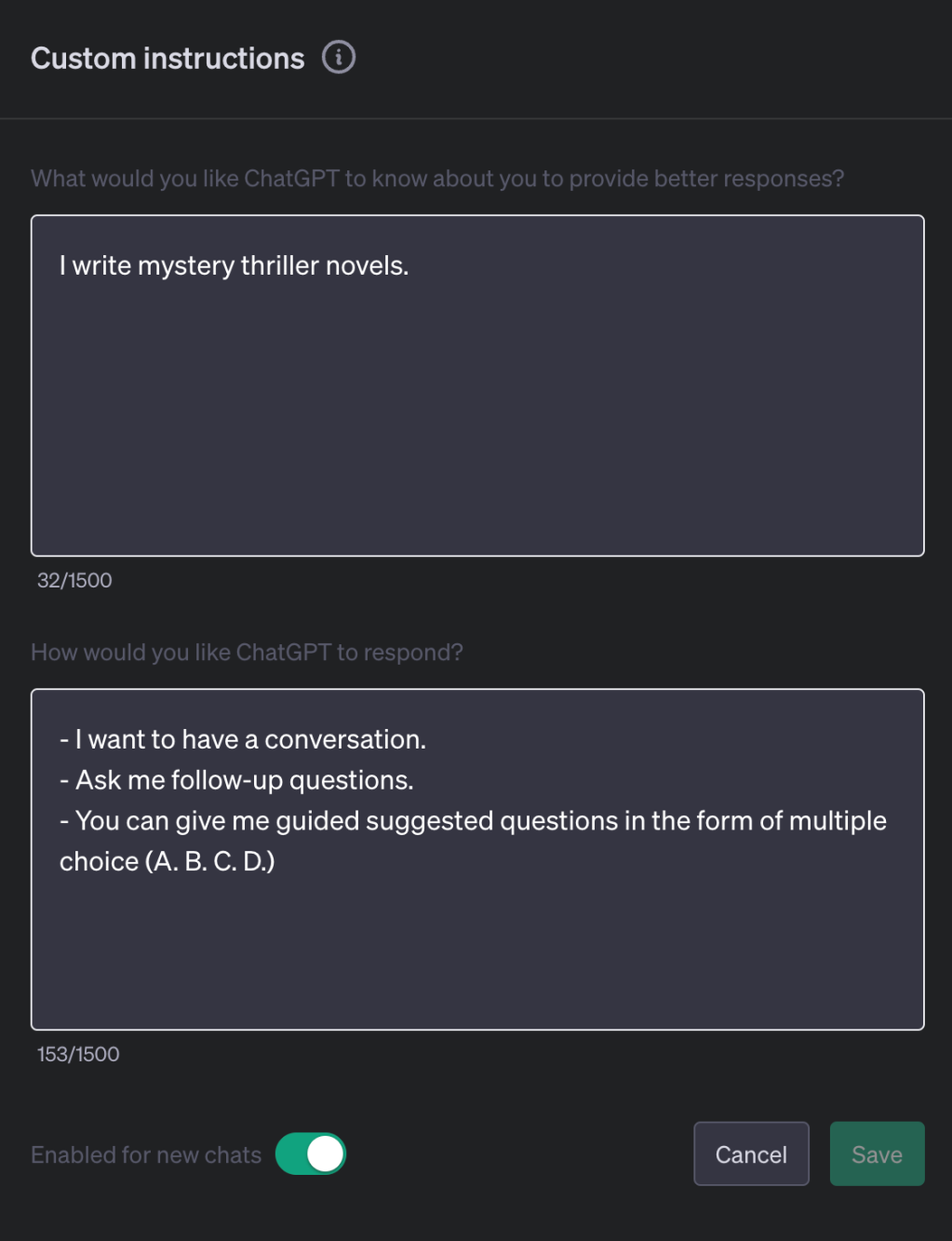
tldr: Custom instructions let you provide ChatGPT with relevant information of your choice about you and how you like to communicate. I’ve use a couple simple tricks to adapt it to my style. I use ChatGPT non-stop for work, fun and exploring. When I write novels it’s a great research helper. When I code it’s…
-

tl;dr: One of the tricks to using GPT-4 well is understanding how it sees text and instructions When we started testing GPT-4 internally last summer one of the first tests people would try is getting it to play the game Wordle. While trying to guess a five-letter word should be simple for an advanced language…
-

tl;dr: OpenAI is testing the ability to run code and use third-party plugins in ChatGPT. OpenAI has announced that we’re developing plugins for ChatGPT that will extend its capabilities. [Link] Plugins range from third-party tools like WolframAlpha and OpenTable, to our browsing plugin and Code Interpreter that can generate code, run code, upload and download…
-

tl;dr: You can use OpenAI’s ChatGPT to bounce ideas around and write story outlines Since I got into the field of AI and started working at OpenAI, it’s been interesting to see how things have accelerated. As an author, I’m frequently asked if AI will replace writers altogether. My personal take is that while AI…
-

OpenAI recently released Whisper, an open source automatic speech recognition model that’s incredibly powerful. I’m biased (I’m the Science Communicator for OpenAI), but in my experience it’s better than any system or service I’ve ever used. Best of all, your can use it completely free, either by downloading it to your computer or by running…
-

TL;DR: OpenAI has a new code generating model that’s improved in a number of ways and can handle nearly two times as much text (4,000 tokens.) I built several small games and applications without touching a single line of code. There are limitations, and coding purely by simple text instructions can stretch your imagination, but…
-
Large models like GPT-3 can perform a variety of tasks with little instruction. That said, one of the challenges in working with these models is determining the right way to do something. GPT-3 has acquired knowledge from its training data as well as another kind of “intelligence” from learning the various relationships between concepts in…
-
GPT-3 is an exceptional mimic. It looks at the text input and attempts to respond with what text it thinks best completes the input. If the first line sounds like something from a romance novel it will try to continue writing in that style. If it’s a list of video games, it will try to…
-
GPT-3 can remember hundreds of items and perform completions with them. This is useful if you want to take your prompts to the next level and do more complex operations.
-

OpenAI’s GPT-3 is a highly capable general language model able to talk about almost anything. While this is an advantage on one hand, it can also make keeping GPT-3 focused on one topic a challenge if you’re trying to create a special purpose chatbot. If you want GPT-3 to talk about movies with a user,…
-
Subscribe
Subscribed
Already have a WordPress.com account? Log in now.
 @AndrewMayne